Bill Gates on AI Risk and Regulation
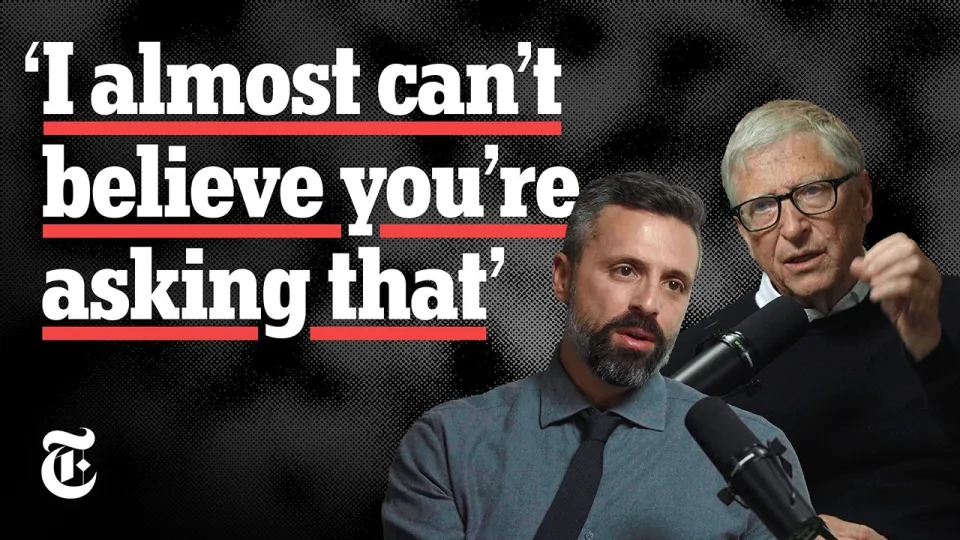
Video: Bill Gates: A.I. ‘Makes Nuclear Weapons Look Like Nothing’ | The Ezra Klein Show
Need articles like this for your video? They help promote it on YouTube and Google — order them in the Telegram bot @sat_sit_bot. Articles with your video embedded are written and posted by the bot itself — on popular topical sites (no ads). Free trial — 50 articles.
· based on the channel The Ezra Klein Show
Key takeaways
- Bill Gates said AI 'makes nuclear weapons look like nothing' in a recent interview.
- He called industry self-regulation 'insane' and urged government oversight.
- Gates warned of catastrophic cyberattacks and bioterrorism within years.
- He predicted mass job loss and proposed taxing AI labor to fund safety nets.
- Gates compared the AI race with China to the Cold War nuclear arms race.
Bill Gates believes artificial intelligence poses a threat that dwarfs nuclear weapons, and he argues that governments must regulate the technology before it causes catastrophic harm. In a recent interview on The Ezra Klein Show, Gates said AI "makes nuclear weapons look like nothing" and called the idea that the industry can self-regulate "insane." The full conversation is available at The Ezra Klein Show podcast page.
What Gates Said About AI's Threat Level
Gates, who co-founded Microsoft and now chairs the Gates Foundation, has shifted from AI optimist to alarmed realist. He told Klein that within a few years, AI could enable cyberattacks and bioterrorism on a scale that would overwhelm existing defenses. His core argument is that AI systems are advancing faster than the safeguards meant to control them, and that the people in charge are not taking the risk seriously enough. In the interview, Gates repeatedly pushed back against the notion that market incentives or voluntary industry standards would prevent disaster. He compared the current moment to the early nuclear age, when only binding international agreements and strict government oversight prevented catastrophe.
Why Self-Regulation Fails for AI
Gates dismissed industry self-regulation as dangerously naive. He pointed out that companies racing to deploy AI face competitive pressure that rewards speed over safety, making voluntary restraints unlikely to hold. When Klein asked whether lawsuits or public pressure could serve as a check, Gates responded with disbelief, suggesting that no legal remedy could address a threat capable of killing millions. He argued that only governments, through coordinated regulation and enforcement, can set and maintain safety thresholds. Gates also noted that the AI industry's own leaders often acknowledge the risks in private but hesitate to slow down in public for fear of losing ground to competitors.
Cyber and Bio Thresholds: The Two Big Dangers
Gates identified two specific areas where AI could cause immediate, large-scale harm: cyberattacks and bioweapons. He warned that AI tools could soon allow small groups or even individuals to launch cyberattacks that disable critical infrastructure, or to design biological agents that cause pandemics. These are not distant science-fiction scenarios in his view; they are plausible within the next few years if capabilities continue to advance unchecked. Gates stressed that the barrier to entry for such attacks is dropping rapidly as AI systems become more capable and more widely available. He urged governments to establish clear red lines and monitoring systems for AI models that could be misused in these domains.
The AI Race With China and the Risk of Arms-Racing
Gates acknowledged the geopolitical dimension: the United States and China are competing fiercely for AI dominance, and neither wants to slow down. He compared the dynamic to the nuclear arms race, where mutual suspicion made cooperation difficult but ultimately necessary. Gates argued that without international agreements, the race will lead to a more dangerous world for everyone. He suggested that the U.S. and China could find common ground on safety standards, similar to how they have cooperated on nuclear nonproliferation in the past. However, he was skeptical that either side would voluntarily cede an advantage without a binding framework.
How AI Will Disrupt Jobs and the Case for Taxing AI Labor
Gates predicted that AI will cause significant job displacement, particularly in white-collar and service roles, and that the transition could be wrenching for millions of workers. He proposed taxing AI labor as a way to fund social safety nets and retraining programs, arguing that if machines replace human workers, the tax system should adapt to capture some of the productivity gains. Gates also floated the idea of "human reserved" jobs—roles that would be legally protected from automation—though he admitted the concept is controversial. He emphasized that without proactive policies, inequality will widen dramatically as the benefits of AI accrue to a small number of companies and individuals.
AI in Education and the Developing World
Gates sees education as one of AI's most promising applications, but he cautioned that without proper regulation, children could be exposed to harmful content or manipulative systems. He called for specific AI regulations designed to protect minors, including age-appropriate design and transparency requirements. On the global stage, Gates argued that AI could help preserve and revitalize endangered languages and improve access to education in developing countries, but he warned that the economic benefits might bypass poorer nations unless deliberate efforts are made to include them. He noted that the Gates Foundation is prioritizing AI as a tool for equality, not inequality.
What Gates's Warning Means for Policy
Gates's message is that AI is not just another technology; it is a dual-use tool with the potential for catastrophic misuse. He urged governments to move quickly to establish regulatory agencies, international agreements, and safety standards, rather than waiting for a disaster to force action. He also called for increased investment in AI safety research and for mechanisms to monitor and audit advanced AI systems. While he remains optimistic about AI's potential to solve problems in health and education, he insists that the risks must be addressed first. The interview makes clear that Gates sees the current trajectory as unsustainable and believes that without intervention, the consequences could be irreversible.
Preguntas frecuentes (FAQ)
What did Bill Gates mean by saying AI "makes nuclear weapons look like nothing"?
Gates was emphasizing that the potential damage from AI—through cyberattacks or bioterrorism—could exceed that of nuclear weapons because AI is more accessible and harder to control. He believes the scale of harm could be unprecedented if the technology falls into the wrong hands.
Why does Gates think self-regulation of AI is "insane"?
He argues that competitive pressure will always push companies to prioritize speed over safety, making voluntary restraints unreliable. Gates believes only government regulation with enforcement power can set and maintain safety standards.
What does Gates propose to address job loss from AI?
He suggests taxing AI labor to fund social programs and retraining, and he has floated the idea of "human reserved" jobs that would be protected from automation. He also emphasizes the need for policies to ensure that AI's benefits are widely shared.
How does Gates view the AI race with China?
He sees it as similar to the nuclear arms race, where competition makes cooperation difficult but necessary. Gates believes international agreements on AI safety are essential to prevent a dangerous escalation.
Conclusion
Bill Gates's warnings about AI are a wake-up call: the technology is advancing faster than our ability to manage it, and the stakes could not be higher. He calls for urgent government regulation, international cooperation, and policies to mitigate job displacement and inequality. For those who want to hear the full argument, the complete interview is available at The Ezra Klein Show. The Ezra Klein Show continues to provide in-depth conversations with leading thinkers on the most pressing issues of our time.
Questions & answers
What did Bill Gates mean by saying AI "makes nuclear weapons look like nothing"?
Gates was emphasizing that the potential damage from AI—through cyberattacks or bioterrorism—could exceed that of nuclear weapons because AI is more accessible and harder to control. He believes the scale of harm could be unprecedented if the technology falls into the wrong hands.
Why does Gates think self-regulation of AI is "insane"?
He argues that competitive pressure will always push companies to prioritize speed over safety, making voluntary restraints unreliable. Gates believes only government regulation with enforcement power can set and maintain safety standards.
What does Gates propose to address job loss from AI?
He suggests taxing AI labor to fund social programs and retraining, and he has floated the idea of "human reserved" jobs that would be protected from automation. He also emphasizes the need for policies to ensure that AI's benefits are widely shared.
How does Gates view the AI race with China?
He sees it as similar to the nuclear arms race, where competition makes cooperation difficult but necessary. Gates believes international agreements on AI safety are essential to prevent a dangerous escalation.
Source: Bill Gates: A.I. ‘Makes Nuclear Weapons Look Like Nothing’ | The Ezra Klein Show · Markdown version